Book One
Broken Strings
A warm comic-fantasy adventure about a young bard, a gift that refuses to stay metaphorical, and the people who become family when the tune goes wrong.
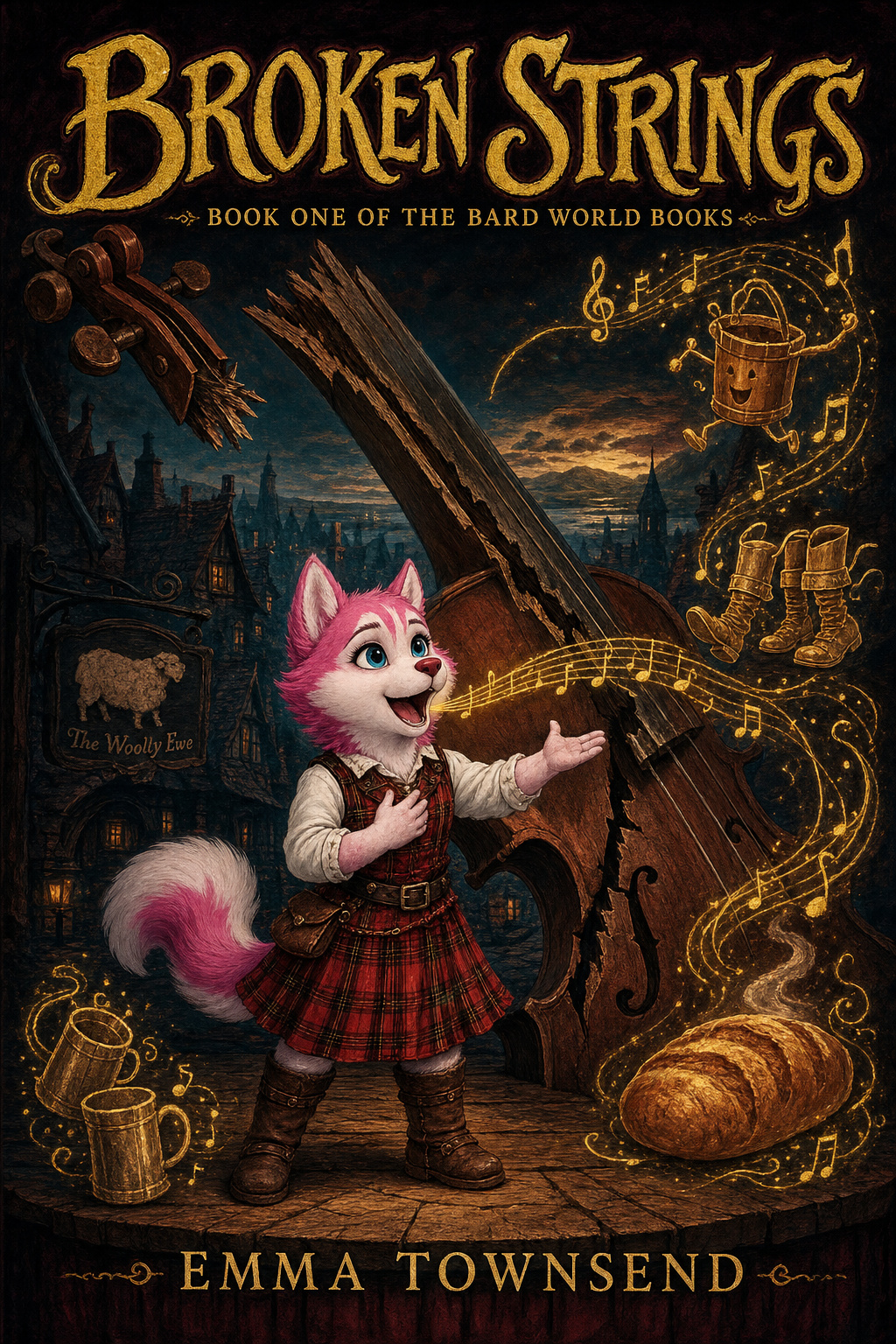 Book One
A Bard World book
Step inside
Read the opening pages, then continue the story in your preferred edition.
Read the opening pages
CHAPTER ONE: THE DOORSTEP
The storm that brought Emma to Dunmoanin was, by later village consensus, the worst in living memory — a claim made with great confidence by people whose memories, on the whole, extended back about four years and involved a great deal of ale.
It had come down off the peaks the way weather always did in the Glenn, gathering itself somewhere up in that high, moody country the village called majestic and everyone else who'd ever bothered to visit called, with a shrug, hills — a disagreement Dunmoanin had never once lost sleep over, on the grounds that the peaks were unquestionably, gloriously theirs, and outsiders were welcome to their opinions same as they were welcome to leave.
Morag Fenwick had heard the wind change an hour before it mattered. She'd been wiping down the bar of the Tipsy Sheep with the particular violence she reserved for nights when the last customer wouldn't leave, and Old Cammidge — three ales past sensible and one past legal in most jurisdictions with functioning law enforcement — had finally taken the hint and stumbled out into weather no sane man would choose. She'd bolted the door behind him with some satisfaction, blown out two of the three lamps, and gone up to bed telling herself the third could wait until morning.
It could not, as it turned out, wait until morning. Nothing about that night waited for anything.
She heard it first as a sound she assumed was the shutter on the west wall doing what it always did in a proper gale, which was complain loudly about its hinges and its lot in life. It was only on the third repetition — a small, wet, insistent sound, entirely unlike a shutter — that she got out of bed, wrapped herself in the blanket rather than bothering with a robe, and went down.
The bundle on the doorstep was not, strictly, on the doorstep. It had been shoved as far under the eaves as the storm's architect had managed, which spoke either of care or desperation, and possibly both, since the two are not always easy to tell apart in the dark during a downpour that seemed personally offended by the existence of the village.
Morag crouched down. She did not gasp, faint, or otherwise perform any of the reactions a doorstep infant is traditionally owed in stories told after the fact, on the grounds that traditions are for people who have time to indulge in them and she was, at that moment, mostly concerned with whether the thing under her hands was breathing.
It was. It was breathing, and small, pale pink and white where fur had come in at all — the color not yet grown into itself, the way an infant's colors rarely are — wrapped in a cape that had clearly once been someone's pride — heavy wool, a clasp shaped like some sort of crest at the collar, badly weathered but not badly enough to hide that it had once meant something to somebody. Beside the baby, tucked into the cape's folds like an afterthought that had actually been the whole point, sat a fiddle with its neck snapped clean through, and a satchel that, when Morag finally got everyone inside and had the presence of mind to look, turned out to be stuffed with paper — songs, in a cramped hand, dozens of them, none signed.
"Right," Morag said, to the baby, to the fiddle, to the storm, to nobody in particular. "Well. You'd better come in, then."
She would spend the better part of the next decade being extremely practical about a decision she had made, in that moment, with no practicality at all.
By morning the whole village knew, because villages of four hundred souls do not require official channels to spread news; a lamp burning at an unusual hour was enough to set the first whispers moving before breakfast was even finished cooking.
Ivan arrived at the Tipsy Sheep before noon, which for a blacksmith mid-commission was itself a kind of proclamation. He came in low under the doorframe as he always did — an old habit, since he'd stopped actually needing to duck years before Morag had known him, but some habits outlive their reasons — with Gemma trailing behind him at the particular half-run of a seven-year-old determined not to be left out of anything ever again.
"Well," said Ivan, looking down at the bundle now sleeping in a drawer Morag had lined with a spare blanket, because a proper crib was not a thing the Tipsy Sheep had ever needed to own. "That's a fiddle."
"It's broken," said Morag.
"I can see that it's broken, Morag. I'm a blacksmith, not blind." He crouched, the way large men crouch around small things, carefully, like the floor might object. "Cape's Magestium make. That clasp — you don't see that kind of ironwork out here." He said Magestium the way most people out here did, distant and half-legendary — the formal name for whatever authority managed magic in the wider world, licensing it, regulating it, keeping its books somewhere in a city neither of them had ever had cause to visit — more rumor to Dunmoanin folk than actual authority, though the clasp itself was proof enough that whoever had worn this cape once stood a good deal closer to that rumor than either of them ever had.
"I don't much care where the clasp is from, Ivan."
"No," he agreed. "Didn't imagine you would."
Gemma, meanwhile, had wedged herself between the two adults with the single-minded focus of a child who understood instinctively that the important thing in the room was down near the floor and not up at eye level
End of preview